Thursday, 28 February 2013
Wednesday, 27 February 2013
葉問:終極一戰【製作花絮】
由英皇電影、國藝影視聯合出品之電影《葉問--終極一戰》,由冼國林監製,邱禮濤執導
故事大綱:
1949年,患有長期胃病的葉問 (黃秋生 飾) 隻身來港謀生,得一班新收徒弟照顧,在港九飯店職工總會天台開始教授詠春。其中當差的
即使生活捉襟見肘,這位一代宗師卻從未折腰,《葉問:終極一戰》還原最真實的葉問,把


Monday, 25 February 2013
Wing Chun Documentary 詠春实录
"Wing Chun" - a documentary sponsored by Shui On Land. The film shows how we can use Wing Chun and its philosophy to improve our daily life, as well as investigating its claims to be scientifically based.
Made in Hong Kong, China and Macau by an international production team, the documentary was directed by Seamus Walsh and produced by Bill Yip.
The film's narrator is Vincent Lo Hong Sui, Chairman of Shui On Land, who shares his story of how Wing Chun has informed both his business and personal life, helping him to become one of Hong Kong's most successful businessmen.
The star of the film is Master Lui Ming Fai, a student of Master Ho Kam Ming and descendant of the Great Grandmaster of Wing Chun, Ip Man. Master Lui takes us through the forms of Wing Chun as well as sharing his insight on it's elegance and practicality. The scientific testing of Wing Chun is provided by Dr. Justin Lee of Chinese University of Hong Kong.
Clip from Wing Chun a documentary. This is part of an interview with sifu Donald Mak at his school in Hong Kong. More information at htt://emptymindfilms.com
Wing Chun has seen explosive growth, fueled by a blockbuster movie and a legion of new followers who regard it as the most effective fighting art there is. "We have seen heat waves before and not just because of Bruce Lee" says Ip Ching, son of Grandmaster Ip Man. Experience Wing Chun in its most authentic setting as we take you on a guided tour of many of Hong Kong's top schools. Although there is only one Wing Chun it has evolved into many styles... from Ip Man Wing Chun to those that continue to develop the martial art as it spreads worldwide. "Even Ip Man modified his kungfu from his practice so we cannot stick to the word genuine anymore" says master Sam Lau, a direct student of Ip Man. Sifu Keung says simply "No matter which branch no one can say their Wing Chun is 100 percent perfect as each have their own way of practicing and if theirs is useless it will disappear."
Watch, listen and learn as teachers and students share their knowledge and experience of the principles, training and practical fighting aspects of Wing Chun. Now widely accepted as one of the most efficient and practical martial arts for both men and women in the world.
Finally a documentary that cuts through all the hype, the myths and the politics to explore Wing Chun in the authentic setting of Hong Kong and ask "is this the most effective martial art in the world?"
Experience Wing Chun in its most authentic setting as we take you on a guided tour of many of Hong Kong's top schools. Although there is only one Wing Chun it has evolved into many styles... from Ip Man Wing Chun to those that continue to develop the martial art as it spreads worldwide. "Even Ip Man modified his kungfu from his practice so we cannot stick to the word genuine anymore" says master Sam Lau, a direct student of Ip Man. Sifu Keung says simply "No matter which branch no one can say their Wing Chun is 100 percent perfect as each have their own way of practicing and if theirs is useless it will disappear."
Watch, listen and learn as teachers and students share their knowledge and experience of the principles, training and practical fighting aspects of Wing Chun. Now widely accepted as one of the most efficient and practical martial arts for both men and women in the world.
Cutting through the hype and the myths to explore Wing Chun in the schools of Hong Kong and ask "is this the most effective martial art in the world?"
Sunday, 24 February 2013
IP Man - The Final Fight 葉問之終极一戰 to open the Hong Kong 37th International Film Festival
IP Man - The Final Fight 葉問之終极一戰 to open the Hong Kong 37th International Film Festival on March 17th, 2013


Wing Chun Weapon, Butterfly Swords -Bat Cham Dao
A Social and Visual History of the Hudiedao (Butterfly Sword) in the Southern Chinese Martial Arts
Consider for instance the “bat cham dao” (the Wing Chun style name for butterfly swords) owned by Ip Man. In a recent interview Ip Ching (his son),confirmed that his father never brought a set of functional hudiedao to Hong Kong when he left Foshan in 1949. Instead, he actually brought a set of “swords” carved out of peach wood. These were the “swords” that he used when establishing Wing Chun in Hong Kong in the 1950s and laying the foundations for its global expansion.
Obviously some wooden swords are more accurate than others, but none of them are exactly like the objects they represent. It also makes a good deal of sense that Ip Man in 1949 would not really care that much about iron swords. He was not a gangster or a Triad member. He was not an opera performer. As a police officer he had carried a gun and had a good sense of what real street violence was.
Ip Man had been (and aspired to once again become) a man of leisure. He was relatively well educated, sophisticated and urbane. More than anything else he saw himself as a Confucian gentleman, and as such he was more likely to display a work of art in his home than a cold-blooded weapon.
Swords carved of peach wood have an important significance in Chinese society that goes well beyond their safety and convince when practicing martial arts forms. Peach wood swords are used in Daoist exorcisms and are thought to have demon slaying powers. In the extended version of the story of the destruction of the Shaolin Temple favored by the Triads, Heaven sends a peach wood sword to the survivors of Shaolin that they use to slay thousands of their Qing pursuers.
Hung in a home or studio, these swords are thought to convey good fortune and a certain type of energy. In fact, it was not uncommon for Confucian scholars to display a prized antique blade or a peach wood sword in their studies. Ip Man’s hudiedao appear to be a (uniquely southern) adaptation of this broader cultural tradition. As carved wooden works of art, they were only meant to have a superficial resemblance to the militia weapons of the early 19th century.
Ip Ching also relates that at a later date one of his students took these swords and had exact aluminum replicas of them created. Later these were reworked again to have a flat stainless steel blade and aluminum (latter brass) handles. Still, I think there is much to be said for the symbolism of the peach wood blade.
Butterfly swords remain one of the most iconic and easily recognizable artifacts of Southern China’s unique martial culture. Their initial creation in the late 18th or early 19th century may have been aided by recent encounters with European cutlasses and military hangers. This unique D-grip (seen in many, though not all cases) was then married to an older tradition of using double weapons housed in a single sheath.
By the 1820s, these swords were popular enough that American and British merchants in Guangdong were encountering them and adding them to their collections. By the 1830’s, we have multiple accounts of these weapons being supplied to the gentry led militia troops and braves hired by Lin in his conflicts with the British. Descriptions by Commander Bingham indicate the existence of a fully formed martial tradition in which thousands of troops were trained to fight in the open field with these swords, and even to flip them when switching between grips. (Whether flipping them is really a good idea is another matter entirely).
Increased contact between Europeans and Chinese citizens in the 1840s and 1850s resulted in more accounts of “double swords” and clear photographs and engravings showing a variety of features that are shared with modern hudiedao. The biggest difference is that most of these mid-century swords were longer and more pointed than modern swords.
Interestingly these weapons also start to appear on America’s shores as Chinese immigration from Guangdong and Fujian increased in the middle of the 19th century. Period accounts from the 1880s indicate that they were commonly employed by criminals and enforcers, and photographs from the turn of the century show that they were also used by both street performers and opera singers.
Still, these blades were in general shorter, wider and with less pronounced points, than their mid. 19th century siblings. While some individuals may have continued to carry these into the 1930s, hudiedao started to disappear from the streets as they were replaced by more modern and economical firearms. By the middle of the 20th century these items, if encountered at all, were no longer thought of as fearsome weapons of community defense or organized crime. Instead they survived as the tools of the “traditional martial arts” and opera props.
While it has touched on a variety of points, I feel that this article has made two substantive contributions to our understanding of these weapons. First, it pushed their probable date of creation back a generation or more. Rather than being the product of the late 19th century or the 1850s, we now have clear evidence of the widespread use of the hudiedao in Guangdong dating back to the 1830s, and a strong suggestion of their presence in the 1820s.
These weapons were indeed favored by civilian martial artists and various members of the “Rivers and Lakes” of southern China. Yet we have also seen that they were employed by the thousands to arm militias, braves and guards in southern China. Not only that we have accounts of thousands of individuals in the Pearl River Delta region receiving active daily instruction in their use in the late 1830s.
The popular view of hudiedao as exotic weapons of martial artists, rebels and eccentric pirates needs to be modified. These blades also symbolized the forces of “law and order.” They were produced by the thousands for government backed elite networks and paid for with public taxes. This was a reasonable choice as many members of these local militias already had some boxing experience. It would have been relatively easy to train them to hold and use these swords given what they already knew. While butterfly swords may have appeared mysterious and quintessentially “Chinese” to western observers in the 1830s, Lin supported their large scale adoption as a practical solution to a pressing problem.
This may also change how we think about the martial arts that arose in this region. For instance, the two weapons typically taught in the Wing Chun system are the “long pole” and the “bat cham do” (the style name for hudiedao). The explanations for these weapons that one normally encounters are highly exotic and focus on the wandering Shaolin monks (who were famous for their pole fighting) or secret rebel groups intent on exterminating local government officials. Often the “easily concealable” nature of the hudiedao are supposed to have made them ideal for this task (as opposed to handguns and high explosives, which are the weapons that were actually used for political assassinations during the late Qing).
Our new understanding of the historical record shows that what Wing Chun actually teaches are the two standard weapons taught to almost every militia member in the region. One typically learns pole fighting as a prelude to more sophisticated spear fighting. However, the Six and a Half Point pole form could easily work for either when training a peasant militia. And we now know that the butterfly swords were the single most common side arm issued to peasant-soldiers during the mid. 19th century in the Pearl River Delta region.
The first historically verifiable appearance of Wing Chun in Foshan was during the 1850s-1860s. This important commercial town is located literally in the heartland of the southern gentry-led militia movement. It had been the scene of intense fighting in 1854-1856 and more conflict was expected in the future.
We have no indication that Leung Jan was a secret revolutionary. He was a well known and well liked successful local businessman. Still, there are understandable reasons that the martial art which he developed would allow a highly educated and wealthy individual, to train a group of people in the use of the pole and the hudiedao. Wing Chun contains within it all of the skills one needs to raise and train a gentry led militia unit.
The evolution of Wing Chun was likely influenced by this regions unique history of militia activity and widespread (government backed) military education. I would not be at all surprised to see some of these same processes at work in other martial arts that were forming in the Pearl River Delta at the same time.
-BENJUDKINS
*Re photo: GGM Ip Man with his swords. Hong Kong, late 1960s.
Friday, 22 February 2013
Wing Chun Ip Man - The Final Fight Trailer《葉問 - 終極一戰》
由英皇電影、國藝影視聯合出品之電影《葉問--終極一戰》,由冼國林監製,邱禮濤執導
故事大綱:
1949年,患有長期胃病的葉問 (黃秋生 飾) 隻身來港謀生,得一班新收徒弟照顧,在港九飯店職工總會天台開始教授詠春。其中當差的
即使生活捉襟見肘,這位一代宗師卻從未折腰,《葉問:終極一戰》還原最真實的葉問,把
Thursday, 21 February 2013
Wednesday, 20 February 2013
Wing Chun / Ving Tsun Chi Sau by Sifu David Peterson
"In effect, Chi Sau gives us the ability to "see" things about the opponent's attack that our eyes cannot see, to 'read his/her intentions' at a neural level, thus accelerating our potential to respond effectively. Practising 'Chi Sau' with 'soft force', or with pre-arranged sequences, unrealistic counterattacks from impossible situations, and the implementation of 'rules of engagement' (such as no attacking to the head, etc.). totally contradict the purpose of the exercise. This is not to say that we have to try to bash our training partner at every opportunity, but that we need to make the drill as close to reality as possible. In combat, if we clash with an opponent, force will be applied, especially the enemy (after all, he/she is trying o hit you!) Therefore, in Chi Sau practice, we need to apply forward force, with an intention to attack if and when an opening occurs or an attack succeeds. The energy used should be flexible, like compressed rubber, not stiff-like solid steel, with firmness and not tension. This approach should begin with the 'single-hand' exercise (Dan Chi Sau) and continue on through to the Gwoh Sau or 'free-attack' stage. Only in this way, free of restrictions and with an emphasis on attacking the man rather than 'chasing the arms', will the Chi Sau drill bear any relevance to real combat."
-David Peterson
"Look Beyond The Pointing Finger
-The Combat Philosophy of Wong Shun Leung"
*Get a copy of this book if you wish to learn and mind-prepare yourself how to survive street combat...for practitioners of all Martial Arts system.

-David Peterson
"Look Beyond The Pointing Finger
-The Combat Philosophy of Wong Shun Leung"
*Get a copy of this book if you wish to learn and mind-prepare yourself how to survive street combat...for practitioners of all Martial Arts system.
The Wing Chun Compendium by Wayne Belonoha
Wing Chun has a number of striking tools at its disposal, from the most popular and common straight punch, to the less used crane fist. While many of these techniques can be used to strike a specific point, the most common weapon is the phoenix eye fist.
The phoenix fist is created by extending the index finger and bending it at the second knuckle. The rest of the fingers are placed like in a regular fist. Place your thumb into the bend of the second knuckle and squeeze to make the fist tight as a rock. Striking is done with the extended knuckle.

The phoenix fist is created by extending the index finger and bending it at the second knuckle. The rest of the fingers are placed like in a regular fist. Place your thumb into the bend of the second knuckle and squeeze to make the fist tight as a rock. Striking is done with the extended knuckle.
A Social and Visual History of the Hudiedao (Butterfly Sword) in the Southern Chinese Martial Arts
The next photograph from the same period presents us with the opposite challenge. It gives us a wonderfully detailed view of the weapons, but any appropriate context for understanding their use or meaning is missing. Given it’s physical size and technology of production, this undated photograph was probably taken in the 1860s. It was likely taken in either San Francisco or Hong Kong, though it is impossible to rule out some other location.
On the verso we find an ink stamp for “G. Harrison Gray” (evidently the photographer). Images like this might be produced either for sale to the subject (hence all of the civil war portraits that one sees in American antique circles), or they might have been reproduced for sale to the general public. Given the colorful subject matter of this image I would guess that the latter is most likely the case, but again, it is impossible to be totally certain.
The young man in the photo (labeled “Chinese Soldier”) is shown in the ubiquitous wicker helmet and is armed only with a set of exceptionally long hudedao. These swords feature a slashing and chopping blade that terminates in a hatchet point, commonly seen on existing examples. The guards on these knives appear to be relatively thin and the quillion is not as long or wide as some examples. I would hazard a guess that both are made of steel rather than brass. Given the long blade and light handle, these weapons likely felt top heavy, though there are steps that a skilled swordsmith could take to lessen the effect.
It is interesting to note that the subject of the photograph is holding the horizontal blade backwards. It was a common practice for photographers of the time to acquire costumes, furniture and even weapons to be used as props in a photograph. It is likely that these swords actually belonged to G. Harrison Gray or his studio and the subject has merely been dressed to look like a “soldier.” In reality he may never have handled a set of hudiedao before.
-BENJUDKINS
*Re photo; 1860s photograph of a “Chinese Soldier” with butterfly swords. Subject unknown, taken by G. Harrison Gray.
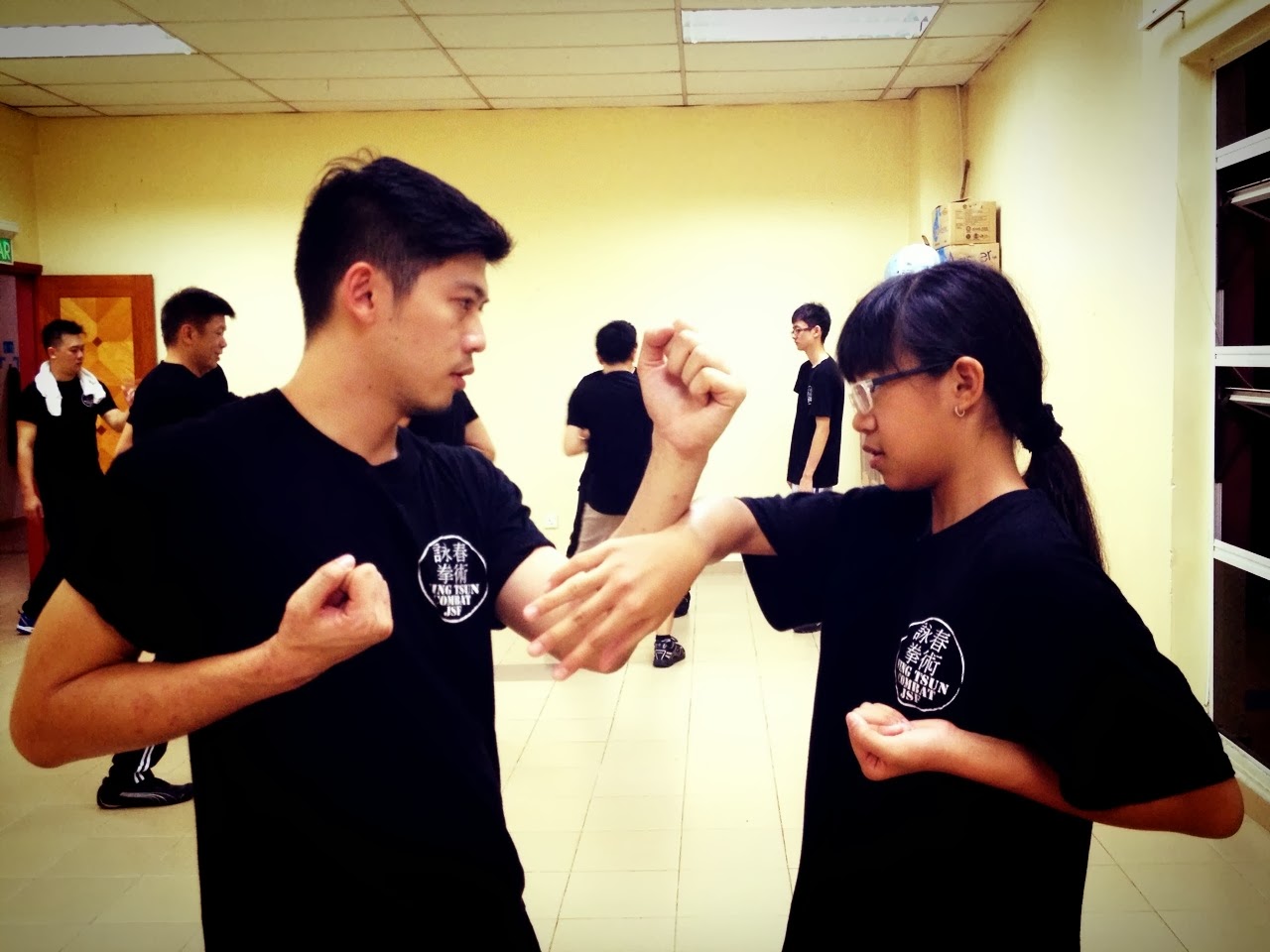
Ving Tsun / Wing Chun Class, Malaysia 詠春拳術班, 馬來西亞
Pusat Komuniti Bandar Manjalara,
Jalan Medan Putra 1,
Bandar Manjalara,
52200 Kuala Lumpur.
Tuesday, 8.00pm-10.00pm
Dewan Orang Ramai Kampung Salak Selatan,
Lot 7895, Jalan Satu, Salak Selatan Baru.
57100 Kuala Lumpur.
Wednesday, 8.00pm-10.00pm
MCA Cawangan,
Jalan Perisa 4,
Taman Gembira,
58200 Kuala Lumpur.
Saturday, 9.00am-11.00am
USJ 16/2A Subang Jaya.
47630 Selangor.
Saturday, 3.00pm-5.00pm
Tokong Dong Teng Keng
16G, Jalan Temiang, 70200,
Seremban. Negeri Sembilan.
Sunday, 8.00am-10.00am
A Social and Visual History of the Hudiedao (Butterfly Sword) in the Southern Chinese Martial Arts
Lastly there are shorter, thicker blades, designed with cutting and hacking in mind. These more closely resemble the type favored by Wushu performers and modern martial artists. Some of these weapons could be carried in a concealed manner, yet they are also better balanced and have a stronger stabbing point than most of the inexpensive replicas being made today. It is also interesting to note that these shorter, more modern looking knives, can be quite uncommon compared to the other blade types listed above.
I am hesitant to assign names or labels to these different sorts of blades. That may seem counter-intuitive, but the very existence of “labels” implies a degree of order and standardization that may not have actually existed when these swords were made. 19th century western observers simply referred to everything that they saw as a “double sword” and chances are good that their Chinese agents did the same. Given that most of these weapons were probably made in small shops and to the exact specifications of the individuals who commissioned them the idea of different “types” of hudiedao seems a little misleading.
What defined a “double sword” to both 19th century Chinese and western observers in Guangdong, was actually how they were fitted and carried in the scabbard. These scabbards were almost always leather, and they did not separate the blades into two different channels or compartments (something that is occasionally seen in northern double weapons). Beyond that, a wide variety of blade configurations, hand guards and levels of ornamentation could be used. I am still unclear when the term “hudiedao” came into common use, or how so many independent observers and careful collectors could have missed it.
-BENJUDKINS
*Re photo;
These hudiedao are more reminiscent of the blades favored by modern Wing Chun students. They show considerable wear and date to either the middle or end of the 19th century. The tips of the blades are missing and may have been broken or rounded off through repeated sharpening. I suspect that when these swords were new they had a more hatchet shaped tip. Their total length is 49 cm. Photo courtesy of http://www.swordsantiqueweapons.com/
Monday, 18 February 2013
Saturday, 16 February 2013
How to Develop Chi Power by William Cheung (Wing Chun Master) 1st Edition 1986
The circulation meridians also belong to the element of fire, and are yin property. Each meridian has nine pressure points. The proper exercise of these pressure points can cure heart trouble and loss of memory.
This book covers Chi Exercises, to promote the flow of chi using the first form of the Wing Chun system 'Siu Nim Tau.'
It is designed to train for improvement of breathing, coordination, concentration, balance, independent movement of the limbs, and mind and body coordination. Most important of all, doing this form improves the
internal energy flow.
This form shown with illustrations is divided into four sections:
1. Commencement; 2. Tan Sao and Fook Sao; 3. Gum Sao and Bil Sao and 4. Tan Sao, Garn Sao, and Bong Sao
How to Develop Chi Power by William Cheung (Wing Chun Master)
The root of the way of life, or birth and change is chi (Qi); the myriad things of heaven and earth all obey this law. Thus chi in the periphery envelopes heaven and earth; Chi in the interior activates them.
The source wherefrom the sun, moon and stars derive their light; The thunder, rain, wind and cloud, their being, the four seasons and the myriad things their birth, growth, gathering and storing; all this is brought about by chi. Man's possession of life is completely dependent upon this chi.
-Nei Ching
Classic of Internal Medicine
2697-2596 B.C.
Philosophy of Wing Chun
One who excels as a warrior does not appear formidable;
One who excels in fighting is never aroused in anger.
One who excels in defeating his enemy does not join issues;
One who excels in employing others humbles himself before them. This is the virtue of non-contention and matching the sublimity of heaven.
The aim of Wing Chun Kung Fu is to develop physical, mental and spiritual awareness. These elements transcend to a higher level of life. Self-awareness, self-respect and a duty to serve should be the goal of every martial artist. The practitioner should meditate on these principles and make peace through the study of Kung Fu- a way of life.
There are six chapters, namely:
Chapter 1: The Nature of Chi: Yin/Yang and the Five Elements
Chapter 2: The Flow of Chi: Pressure Points and Meridians
Chapter 3: Promoting the Flow of Chi: Chi Exercises
Chapter 4: Techniques: Basic Arm Movements
Chapter 5: Cultivating Chi: Siu Nim Tao
Wing Chun techniques combined into an exercise for training reflexes, coordination, and improving power through the cultivation of Chi.
Chapter 6: Engaging an Opponent's Chi: Basic Chi Sao Exercises
About the Author:
William Cheung 張卓慶 is a Chinese Wing Chun Gung Fu practitioner and currently the Grandmaster of his lineage, Wing Chun 'Traditional Wing Chun' (TWC).
William Cheung attained Bachelor of Economics from the Australian National University, after graduating from secondary school in Hong Kong. William Cheung is also a certified Doctor of Chinese Medicine under the Chinese Medicine Registration Board of Victoria, and a member of the Australian Chinese Traditional Orthopaedics Association Inc. He has also been invited as a Guest Professor to Foshan Sports University (China), and as a Senior Research Professor of the Bone Research Department to Beijing Chinese Medical University (China).
At a young age William Cheung started his training in Wing Chun Gung Fu under the Great Grandmaster Ip Man.
Friday, 15 February 2013
Ving Tsun / Wing Chun Master Wong Shun Leung's ANSWER
Ground Fighting
Wong Shun Leung's Answer on the Question of "From the fights that you had, did you find that you needed to fight on the ground?"
"The situation where you need to wrestle is when both opponents want to grab. Western boxing is supposed to be hitting, but you still see situations where they want to hold on to each other. This is because one of them is scared. If you are scared then you will try to hold onto your opponent. It is very difficult for someone to lock or hold onto you if you know Wing Chun. You can stop the other guy holding or grabbing. If someone grabs you, you will only try to grab back if you are scared. But if you are not scared, then he cannot force you into a wrestling situation."
Subscribe to:
Posts (Atom)